Embra Intelligence. Simplify SAP.

Embra understands your SAP landscape, processes, and business logic in every detail — and puts that knowledge to work in your daily business.

  • Custom code
  • Configuration
  • Processes
  • Business context
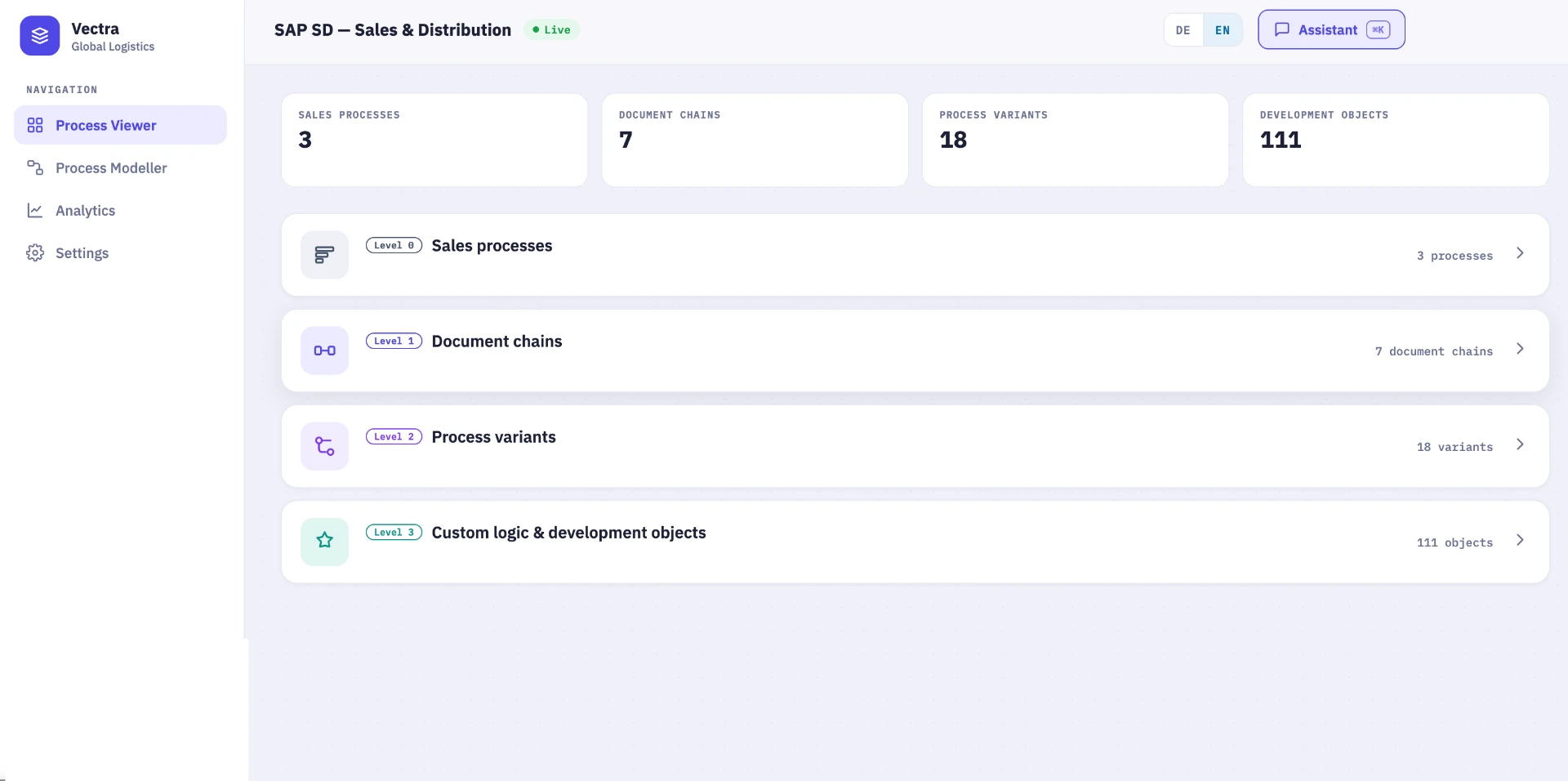
Embra Intelligence — process analysis dashboard for SAP SD Sales & Distribution

AI needs context. We provide it.

Embra gives AI the context it needs to work in your SAP landscape — in daily operations, in projects, and throughout your S/4HANA transformation.

The what and how

System context

Deterministic analysis of your custom code and configuration.

The where and when

Process context

Reconstructed from what actually happens in your system — not from outdated documentation.

The why

Business context

The business reasoning behind code and configuration — the one layer no system can provide.

We bring these three layers together in a knowledge graph — a connected model that links information and the relationships between it. That way, Embra doesn't just understand individual facts, but how processes, system settings, and business logic fit together. This is what enables Embra not just to analyze, but to act. How much Embra is allowed to do on its own is up to you.

Use cases

Tickets, projects, S/4HANA transformation — more speed in every area

Ticket handling

Verify, don't search

A ticket rarely contains the information needed to resolve it — and a lot of time is lost in the back-and-forth between requester and resolver. The analysis itself is no less demanding: to find the root cause, the resolver first has to work through the affected process and debug test orders. With Embra, clarification starts the moment the ticket is raised: Embra asks the follow-up questions itself, gathers the information it needs, investigates the problem, and narrows down the root cause. The resolver reviews the findings and fixes the issue — or lets Embra take care of that too.

Projects

Less time researching, more time deciding

80% research, 20% implementation — the biggest time sink in project work is rarely the implementation itself, but the research that comes before it: How does a particular process actually work? Do we already have a solution for this requirement somewhere in the system? Answering these questions normally takes days or weeks. With Embra, you get the answers in seconds.

  1. Requirements analysis

    Requirements are built on facts. Business teams and consultants explore processes directly in the Process Modeller — and the knowledge graph answers open questions in seconds.

  2. Solution design

    In the Process Modeller, you extend the process or design it from scratch — combined with the requirements, Embra derives the implementation concept from it.

  3. Configuration & implementation

    The approved concept becomes a work order. Embra proposes the configuration entries, master data changes, and developments needed to implement the requirements. The team reviews the proposals: consultants maintain the required settings while developers code with full system context in their IDE. And to the extent you allow it, Embra implements approved changes itself.

  4. Testing & UAT

    Embra derives test cases deterministically from the modelled process — for every process variant, including the edge cases that manual test design tends to miss.

  5. Go-live & hypercare

    Embra's role doesn't end at go-live: it documents what was built and provides the context for every future ticket. The knowledge stays in the graph — not spread across people who will eventually leave the company.

Supporting your S/4HANA migration

S/4HANA: Less analysis overhead, more architectural freedom

Process discovery

Your as-is processes come from the system

Greenfield, brownfield, or bluefield — every S/4 transformation starts with process analysis. And that analysis is demanding: it often drags on for months, and choosing the right level of detail is hard. Embra derives your processes automatically from the system, based on how you define your process variants — detailed enough for a clear overview. Anything deeper, you ask the chat.


Custom code

Every finding in its process context

ATC and the Custom Code Migration app show you where your code needs to change. What they don't show: which finding affects which process, and what consequences a change has elsewhere. A finding in the pricing exit for export orders carries a different weight than one in a decommissioned legacy report. That connection is what the knowledge graph delivers.

Impact

Know the consequences before they hit

Every change has a blast radius. Embra makes it visible: which programs, interfaces, and process variants depend on a finding — including through the configuration tables that static checks never see. So it's clear where thorough testing is needed and where it isn't. Because what makes a project expensive isn't rewriting code — it's testing.

Fit-to-standard

Deviations documented, not remembered

A complete picture of where your system actually deviates from the SAP standard — so workshops start with evidence instead of recollections.

And above all

Freedom to decide

Custom development has always come with follow-on costs: over the years, functionality accumulates in the system until no one has the full picture anymore. Maintenance and further development keep getting more expensive — precisely because the explanatory layer that Embra provides has been missing. A common consequence: companies try to get the problem under control by rebuilding S/4HANA on a greenfield, moving custom code to the Business Technology Platform, and keeping processes as close to standard as possible under the clean-core principle. Projects like these are extremely challenging. There are plenty of examples of failed greenfield implementations that burned many millions. Every company has to develop its own migration strategy, and there may be good reasons to go greenfield. But the complexity of your own system shouldn't be one of them. After all, your custom code exists for a reason: because the process, in exactly this form, sets you apart from your competitors — and the standard doesn't cover it. Processes that carry your business shouldn't have to be bent out of shape just to get rid of the complexity. Embra handles the complexity for you.

FAQ

Frequently asked questions

Team

Built by SAP people, for SAP people

Built by SAP consultants and developers — as the tool we always missed in our own project work.

Get to know us and the system

We'll show you how Embra makes your SAP team faster.